Keys, Ink, and Imperfection: How Typewritten Poetry Became BookTok's Most Unexpected Obsession
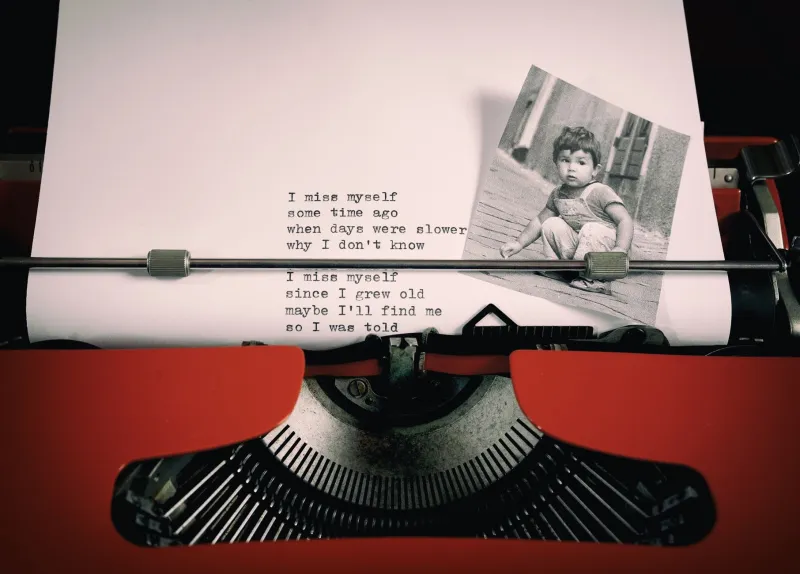
There's a particular kind of video that keeps showing up on BookTok lately. The lighting is warm, almost amber. A sheet of paper sits in the carriage of a vintage typewriter — a Hermes 3000, maybe, or a battered Olympia SM9 someone rescued from a Goodwill in Ohio. The poet types slowly. The keys clack. The ribbon smears just slightly on the letter e. And when the poem is done, they pull the page free with that satisfying mechanical rip, hold it up to the camera, and just let it exist.
No filters. No perfectly kerned font. No aesthetic template pulled from Canva at midnight.
Just a poem, a little crooked, on a piece of paper that smells faintly of machine oil.
These videos are racking up hundreds of thousands of views, and the comment sections read less like social media and more like a collective exhale.
Why Now? Why This?
To understand the typewritten poetry moment, you have to understand what it's reacting against.
Digital poetry — the kind that lives on Instagram, Tumblr, and Pinterest — spent the better part of the last decade optimizing itself into a corner. Clean sans-serif fonts. Pastel backgrounds. Bite-sized stanzas engineered to screenshot well. Some of it was genuinely moving. A lot of it started to feel like content dressed up as feeling.
Algorithms reward consistency and legibility. They reward the thing that looks like the thing that already worked. And somewhere along the way, a generation of readers and writers started to notice that a lot of what was being served to them felt less like poetry and more like a mood board with line breaks.
The typewriter offers the opposite of that. It's commitment without the option to undo. It's a medium that leaves evidence of its own making — the heavier strike on a letter where your finger tensed up, the slight drift of a line when the paper wasn't quite straight. These aren't flaws to be corrected. For the poets showing up on BookTok, they're proof that a human being sat down and made something.
"There's no ctrl-Z on a typewriter," says Maya Delacroix, a 24-year-old poet and BookTok creator based in Portland who goes by @inkandcarriage online. "Every poem I post is the real first draft. Sometimes I cross things out by hand. People go wild for the crossed-out lines. They say it makes them feel like they're reading something private, something real."
The Aesthetic That Isn't Just Aesthetic
It would be easy — and a little lazy — to write this off as another retro trend, another Gen Z nostalgia trip for an era they never actually lived through. And sure, part of the typewriter's appeal is visual. The aged paper, the uneven type, the tactile evidence of physical effort — it photographs beautifully in a way that feels genuinely different from everything else in a scroll.
But talk to the people actually doing this, and the conversation goes somewhere deeper pretty fast.
Jordan Tse, 22, runs a small online poetry zine out of Chicago called Strikeover — named for the old typist's trick of correcting a letter by typing over it. The zine accepts only typewritten submissions, scanned and published in their original, imperfect form. It launched eight months ago with a modest following. Today it has a waitlist of contributors.
"I started it because I was tired of reading poetry that felt like it had been through a committee," Tse explains. "When someone submits to us, I can see where they hesitated. I can see where they changed their mind. The poem carries its own history in a way a Word document just doesn't."
That idea — the poem as artifact, as object with a history — is central to why this movement resonates. In a digital landscape where content is infinitely reproducible and endlessly editable, a typewritten poem is singular. There's only one original. Even scanned and uploaded to the internet, it retains the ghost of its physical existence.
BookTok Does What BookTok Does
Of course, none of this would have reached critical mass without the platform that has quietly become the most influential literary community in America.
BookTok has a well-documented superpower: it takes things that feel niche and personal and makes them feel universal. It did it with romantasy. It did it with slow-burn enemies-to-lovers. And now it's doing it with a bunch of poets sitting alone in their apartments, typing by lamplight.
The format suits the content almost suspiciously well. A 30-second video of someone typing a poem, revealing it, reading it aloud — it hits the same emotional register as ASMR, the same intimacy as a voice memo from a friend. The rawness of the medium translates directly into the rawness of the feeling. Viewers aren't just reading a poem. They're watching it get made.
"BookTok gave this permission to be slow," says Delacroix. "It's the one corner of the internet where people will actually sit still for something that takes time."
The Poets Leading the Charge
Beyond the individual creators, a loose ecosystem has started to form. Small presses like Strikeover are joined by others — Carbon Copy Quarterly out of Brooklyn, Ribbon & Return based in Austin — all publishing typewritten work with a commitment to preserving the original document's texture and imperfection.
Poetry open mics in cities like New York, LA, and Seattle have started hosting "analog nights" where readers are encouraged to bring typewritten pages rather than reading from their phones. The difference in the room, by all accounts, is palpable. There's something about holding paper, about the slight performance of unfolding it, that changes the energy of the space.
And a growing number of poets are using the typewriter not just as an output device but as a compositional tool — arguing that the physical resistance of the keys, the inability to delete, forces a different kind of thinking. Slower. More committed. Less prone to the endless second-guessing that a blinking cursor seems to invite.
Imperfection as Resistance
At its core, what's happening with typewritten poetry on BookTok is a quiet act of refusal. A refusal to optimize. A refusal to make the work frictionless, frictionless, frictionless until it loses all texture.
The smudged ink is a choice. The crooked line is a statement. The crossed-out word left visible on the page is an argument that the process of making art is itself part of the art — that the evidence of a human mind working through something matters, and shouldn't be hidden.
In a moment when AI can generate a poem in two seconds that looks exactly like a poem and means nothing in particular, the typewriter has become a kind of proof of presence. A timestamp on a feeling. A ghost made visible in the machine.
And apparently, that's exactly what a lot of people needed to see.