Every Rack Is a Gallery: How Gen Z Turned Thrifting Into a Full-Blown Curatorial Art Form
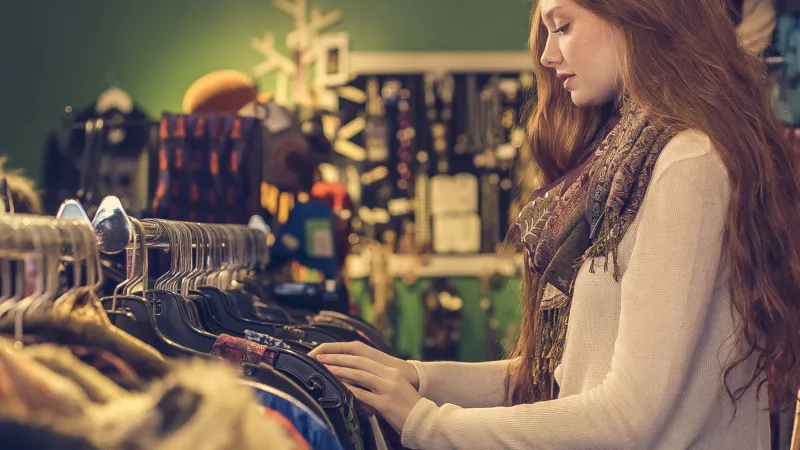
There's a particular kind of focus that settles over someone when they're deep in a thrift store rack. Fingers moving methodically through hangers, eyes scanning for something they couldn't have described before they saw it. It looks casual. It's anything but. For a significant slice of Gen Z, that ritual carries the same intentionality as a museum director pulling pieces for a retrospective — except the gallery is their wardrobe, and the admission price is whatever Goodwill is charging for a 1987 Levi's trucker jacket this week.
What started as a budget-friendly workaround has quietly evolved into one of the most sophisticated expressions of personal taste happening in American culture right now. And most people walking past those donation bins still haven't caught on.
From Broke to Deliberate
Let's be honest about the origin story. Thrifting wasn't always a philosophy. For a lot of people — including plenty of Gen Z kids — it was just what you did when money was tight. Church rummage sales, Salvation Army runs, the back corner of a Goodwill where nothing is organized and everything smells faintly like cedar and someone else's decade. That was the unglamorous truth of secondhand shopping for most of its modern history.
But something shifted. Partly it was economic — student debt, housing costs, and stagnant wages made frugality less of a choice and more of a condition. Partly it was environmental — the documentary footage of textile waste mountains, the exposés on fast fashion labor practices, the creeping guilt of buying a $12 shirt that falls apart in six weeks. And partly, honestly, it was aesthetic. At some point, the thrift store started producing better stuff than the mall.
When all three of those forces converged, thrifting stopped being a fallback and became a stance.
The Hunt as Practice
Ask anyone deep in the thrifting world what keeps them coming back, and they'll almost never say "saving money" first. They'll say the hunt. That phrase gets thrown around a lot, but it's worth sitting with what it actually means psychologically.
Curators — real ones, the kind who work in institutions — talk about the same thing. The process of moving through a collection, of holding something and deciding whether it belongs, whether it earns its place, whether it says something true. There's a cognitive pleasure in that discernment that's genuinely addictive. Thrifting, at its most intentional, delivers exactly that experience — just with more fluorescent lighting and a 50% off color tag on Tuesdays.
The unpredictability is the whole point. You can't browse a thrift store the way you browse ASOS. There's no filter for "oversized linen blazer, camel, size medium." You walk in with an open sensibility and you either find something or you don't. That randomness, paradoxically, is what makes the finds feel meaningful. It's the difference between downloading a song and discovering it on the radio at exactly the right moment.
Influencers Who Actually Get It
Social media has been both a blessing and a complication for thrift culture. On one hand, creators like Wisdom Kaye, Alyssa Coscarelli, and a whole ecosystem of smaller "thrift flip" accounts have made the practice genuinely aspirational — showing audiences that a $4 blazer and a good eye can produce something more interesting than anything in a fast fashion haul. On the other hand, the visibility has driven up prices and crowded stores in ways that have real consequences for lower-income shoppers who depend on those same aisles.
The most compelling voices in this space aren't the ones doing dramatic before-and-afters or chasing algorithmic virality. They're the ones treating their thrifted wardrobes as actual archives — documenting provenance, talking about why a particular piece matters, building a coherent visual language across everything they own. That's curatorial thinking. That's someone asking not just "does this look good" but "what does this say, and does it belong in the story I'm telling about myself."
It's the same question a collector asks before they hang something on their wall.
What You Wear Is What You Argue
There's a political dimension to all of this that doesn't get named enough. Choosing to opt out of fast fashion's churn — even partially, even imperfectly — is a position. It's a quiet argument against the idea that novelty is always better than depth, that newness is inherently superior to history, that your value as a consumer is measured by how much you buy and how recently.
Gen Z, more than any generation before them, seems genuinely allergic to the performance of consumption for its own sake. They've grown up watching brands manufacture authenticity. They're pretty good at spotting the difference between a thing that has a story and a thing that was marketed to seem like it does. A thrifted piece — one with actual wear, actual history, actual evidence of a previous life — can't be faked. That realness matters to a generation that's been sold unreality at scale since birth.
There's also something quietly radical about building an identity through accumulation rather than purchase. When your wardrobe is assembled from a hundred different eras, contexts, and previous owners, it resists easy categorization. You can't be reduced to a customer segment. You're something harder to market to, which in 2025 feels almost like a superpower.
Building a Wardrobe Like a Collection
The most interesting thrifters aren't just hunting for individual pieces — they're thinking in terms of coherence. What does this add? What does it complicate? Does it push the whole thing somewhere new or does it just take up space?
That's exactly how a good curator thinks about a gallery wall, or a collector thinks about adding to a body of work. The individual object matters less than the conversation it creates in context. A vintage Western shirt next to a 90s windbreaker next to a deadstock band tee from a band you've never heard of — that's not chaos, that's composition.
The thrift store, in this reading, isn't a discount retail experience. It's a raw archive. Unorganized, unpredictable, occasionally frustrating, but full of material with actual weight to it. Your job — if you're approaching it with any real intentionality — is to walk through that archive and pull out the pieces that mean something. To you, to the story you're building, to the visual argument your wardrobe is quietly making every time you leave the house.
The Closet as Statement
There's a version of thrifting that's still just bargain hunting, and there's nothing wrong with that. But what's happening on the more deliberate end of this culture is something genuinely worth paying attention to. It's young people developing a real aesthetic philosophy — one built on patience, sustainability, personal history, and a healthy skepticism toward the idea that what's new is what's good.
Arvanon has always been interested in the places where taste becomes something more than preference — where the things people choose say something true about who they are and what they value. A thrift store rack, approached with the right kind of attention, is exactly that kind of place.
Somebody's out there right now, fingers moving through hangers, looking for the piece that completes something. That's not shopping. That's curation.