Clack Therapy: How the Mechanical Typewriter Became the Creative Tool of a Burnt-Out Generation
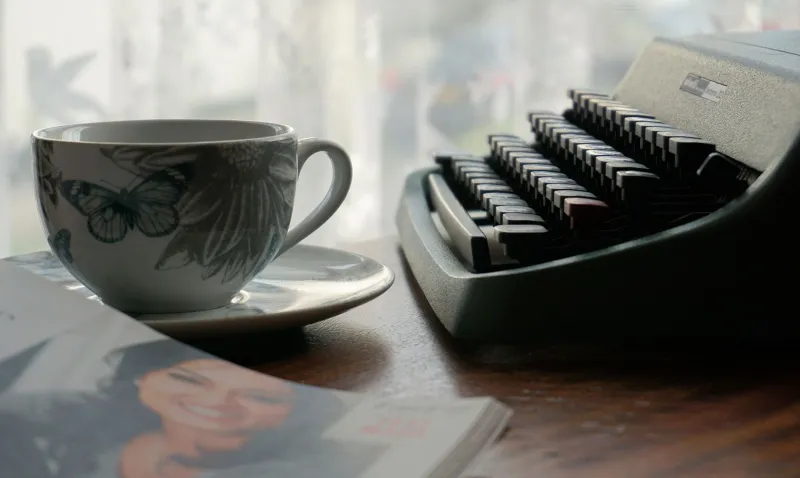
There's a particular sound that's been drifting out of coffee shops, Brooklyn apartments, and Pacific Northwest writing retreats lately. It's not a notification ping. It's not a lo-fi playlist. It's the sharp, deliberate clack-clack-ding of a mechanical typewriter — and if you've heard it recently, you already know how weirdly satisfying it is to be near.
The typewriter is having a moment. Not in a kitschy, ironic, put-it-on-a-tote-bag kind of way. Writers — real ones, working ones, published ones — are pulling these machines out of thrift stores, estate sales, and vintage shops and actually using them. Every day. To do their jobs. And the reasons why say a lot about where we are right now as a culture that can't stop staring at glowing rectangles.
The Screen Is the Problem
Let's be honest about something: writing on a laptop is a disaster for the creative brain. Not because laptops are bad tools, but because they are too many tools at once. You open a document and within four minutes you've checked email, spiraled on Twitter, researched something you didn't need to research, and lost whatever sentence was forming in your head. The internet isn't a feature of the writing experience anymore — it's the main character, and your actual work is the subplot.
This is the specific frustration that's sending writers back to analog. A typewriter has one function. It does not ping you. It does not suggest edits. It does not autosave to a cloud or ask you to update its software. It just waits, heavy and mechanical, for you to say something.
For a generation that grew up with ADHD diagnoses, pandemic-era burnout, and the particular exhaustion of living inside an attention economy, that single-purpose simplicity isn't retro — it's revolutionary.
Friction as a Feature
Here's the thing nobody tells you about typewriters until you actually use one: they push back. Every key requires real pressure. Every mistake is permanent unless you reach for the Wite-Out. You can't select-all and delete. You can't drag a paragraph to a different page. The machine demands commitment from you in a way that a backspace key fundamentally does not.
For a lot of writers, that friction has turned out to be exactly the point.
When you know you can't easily undo something, you think harder before you type it. When every word costs a little physical effort, you stop padding sentences. The prose tightens up. The thinking sharpens. There's something almost meditative about the process — the rhythm of the keys, the carriage return, the bell at the end of a line — that gets your nervous system out of fight-or-flight mode and into something that actually resembles flow.
Poets especially seem to have caught on. There's a whole micro-community of typewriter poets operating out of farmers markets and street fairs across the US — people who will write you a custom poem on the spot, on a vintage machine, for a few bucks. It's performance art and commerce and craft all at once. And the poems are good. The constraint makes them good.
Vintage Machines, Very Online Communities
If you want to understand how serious this movement has gotten, just look at the online infrastructure that's grown up around it. Reddit's r/typewriters has hundreds of thousands of members trading restoration tips, debating the merits of Olympia versus Hermes versus Royal, and posting glamour shots of their machines the way sneakerheads post grails. The hashtag #typewriterclub has millions of views on TikTok. Antique stores that used to dust off their typewriter inventory are now selling out before items hit the floor.
Shops like California Typewriter — the subject of a full documentary — have become pilgrimage destinations. Tom Hanks, famously one of the most devoted typewriter collectors in the country, has written extensively about his collection and even released a book of short stories that began as typewritten drafts. He's not alone in the celebrity tier: Quentin Tarantino has long maintained that he writes his screenplays by hand and typewriter first, and credits that physical process with keeping his voice intact.
But the movement isn't driven by famous people. It's driven by 24-year-old MFA students and freelance journalists and novelists working their second jobs who found a $40 Smith Corona at a Goodwill and never looked back.
What Screenwriters and Novelists Are Actually Saying
Talk to working writers about their typewriter practice and you start hearing the same themes over and over. The word permission comes up a lot. Something about the typewriter gives writers permission to be bad on the first draft — maybe because the impermanence of a digital document makes every sentence feel like it should already be good, while a typewritten page feels explicitly like a rough thing, a working thing, something in process.
The word presence comes up too. Being with the machine, in the room, without a browser open, without a playlist to curate or a message to answer — that quality of presence is something writers describe almost like a spiritual practice. Some people meditate. Some people journal. Some people sit down at a 1960s Olivetti and type until something true comes out.
Screenwriters in particular talk about how the typewriter changes their relationship with structure. When you can't cut and paste, you have to know where you're going before you go there. That pre-thinking, that outlining in your head before your fingers move, produces a different kind of story architecture — one that feels more deliberate, more inevitable.
The Object Itself Matters
There's also just the physical reality of these machines to reckon with. Typewriters are beautiful objects. Heavy, chrome-detailed, color-blocked in ways that feel more considered than anything manufactured today. A 1950s Hermes 3000 in seafoam green is genuinely a design object. It earns its place on a desk. It changes the energy of a room.
This matters more than it might sound. Your environment shapes your creative output — we know this. And there's something about having a machine on your desk that is only for writing, that has no other function, that carries the weight of everyone who ever typed on it before, that makes the act of sitting down to write feel more intentional. More like something worth doing.
In a culture that has optimized everything for frictionlessness and convenience, the typewriter is an argument for the opposite. It says: some things are worth the difficulty. Some processes deserve to be slow. Some creative work needs resistance to become real.
The Clack Heard Around the Room
The typewriter renaissance isn't nostalgia, exactly. It's not about wanting to live in a different era or romanticizing a past that wasn't great for a lot of people. It's about finding, in an old technology, a solution to a very new problem — the problem of trying to think deeply inside a machine designed to keep you from doing exactly that.
Writers are figuring out that the best tool isn't always the most advanced one. Sometimes it's the one that gets out of your way. Sometimes it's the one that makes a sound you can feel in your chest. Sometimes it's the one that forces you to commit to the word before you type it, because once it's on the page, it's there.
The clack of a typewriter key is the sound of someone deciding something. In 2024, that might be the most creative act of all.