Mud Season: How the Pottery Studio Quietly Became the Community Center We All Needed
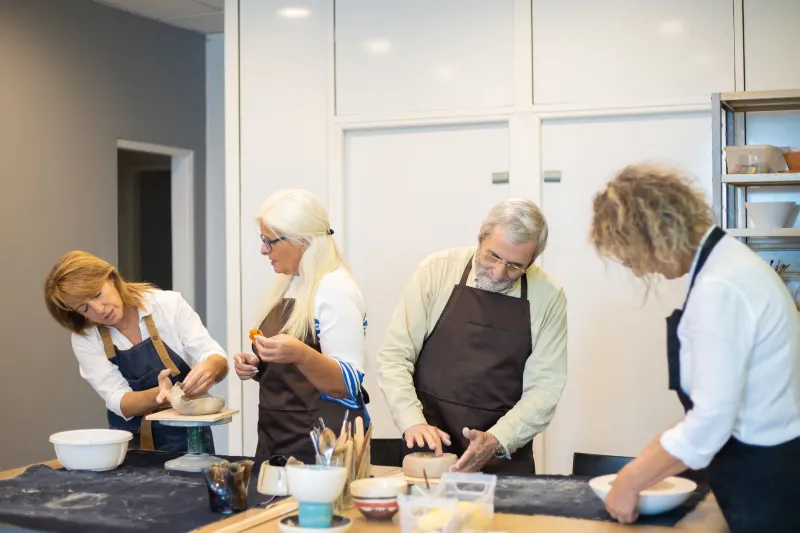
On a Tuesday night in Denver, twelve people are hunched over pottery wheels in a converted warehouse space that smells like wet earth and coffee. Half of them are beginners. A few are regulars who've been coming every week for two years. One guy — bearded, mid-forties, wearing a clay-splattered flannel — is attempting his fourth bowl of the evening after the first three collapsed. He's laughing about it.
"I'm a software engineer," he says, without anyone asking. "This is the only part of my week where failure is kind of the best-case scenario."
This is Groundwork Studio, one of dozens of independent ceramics spaces that have opened or dramatically expanded across US cities in the past four years. And what's happening here on a Tuesday night isn't just a craft class. It's something harder to name — closer to a ritual, or a neighborhood bar, or the kind of place you start showing up to even when you don't have a reason.
The Numbers Behind the Mud
The ceramics boom is real and it's measurable. Google searches for "pottery classes near me" have more than doubled since 2020. Studios in cities like Portland, Nashville, Philadelphia, and Los Angeles report waitlists stretching months out. The American Craft Council has noted sustained growth in clay-focused programming across the country, and platforms like ClassPass have seen ceramics consistently rank among their most-booked creative offerings.
The timing isn't accidental. The pandemic broke something in the way people understood community — and when restrictions lifted, a lot of us discovered we'd lost the casual, low-stakes social infrastructure that used to hold daily life together. The third place: that concept sociologist Ray Oldenburg described as the space between home and work where community actually happens. Pottery studios, it turns out, are filling that gap in ways that gyms and coffee shops haven't quite managed.
"People come in saying they want to learn a skill," says Dani Okafor, who co-owns a studio called Soft Clay in Atlanta. "But they stay because of the people. I have regulars who've become genuinely close friends. Some of them met here and now they carpool. One couple got engaged."
Why Clay, Specifically?
There's something about the physical nature of ceramics that seems to lower people's defenses in a way that other creative pursuits don't. Painting can feel precious. Knitting is portable and solitary. But pottery demands your full body and your full attention — you can't be on your phone when your hands are covered in slip and a cylinder is threatening to wobble off-center.
That enforced presence is part of the appeal. So is the fact that clay is unforgiving in a strangely comforting way. It doesn't care about your job title or your follower count. It responds to touch, to pressure, to patience. You can't fake your way through a centered bowl.
"There's an equity to it," says Priya Nair, a regular at a studio in Chicago who started taking classes after burning out at a marketing job. "Everyone is bad at first. Your hands don't know what to do. And watching other people struggle with the same thing you're struggling with — there's a solidarity in that."
The meditative dimension matters too. Therapists have been incorporating clay work into treatment for decades, and the tactile, repetitive motion of wedging and throwing has documented stress-reduction benefits. But the people filling up Tuesday night open studio sessions aren't necessarily coming in search of therapy. They're coming in search of something to do with their bodies that isn't staring at a screen — and finding, almost by accident, that it quiets something.
The Social Architecture of the Studio
What makes ceramics studios function as community spaces — rather than just classes you attend — is the structure of how time works there. Unlike a yoga class or a cooking workshop that begins and ends on a clock, a ceramics practice has a longer arc. You throw your pieces one week, trim them the next, glaze them the week after. You're always in process. And that means you keep coming back.
"The continuity is everything," says Marcus Tello, who teaches at a studio in Seattle. "You see the same people week after week. You ask about each other's pieces. You remember that someone was trying to figure out a glaze problem two weeks ago and you ask how it turned out. That's how relationships build."
Studios are increasingly designing for this. Many now have open studio hours where members can come in and work independently, creating the kind of ambient social space that a good coffee shop offers. Some host glazing parties, kiln-opening events — there's genuine communal ritual around the moment when a kiln is opened and everyone sees how their pieces came out. The anticipation, the occasional heartbreak of a cracked piece, the unexpected beauty of a glaze that did something surprising — these are shared experiences that become shared language.
Democratizing a Craft with a Class Problem
Historically, ceramics has had an access issue. Wheel-throwing required expensive equipment, dedicated studio space, and instruction that wasn't always affordable or geographically available. The current wave of studios is actively working against that history.
Many are offering sliding-scale memberships, scholarship programs, and community kiln access for people who can't afford full tuition. Some are partnering with community colleges, public libraries, and arts nonprofits to bring ceramics programming into neighborhoods that wouldn't typically have it.
"Fine craft has always had gatekeepers," Dani Okafor says. "We're trying to be the opposite of that. The wheel doesn't care who you are. We shouldn't either."
That openness is part of what's drawing a younger, more diverse demographic to the craft — people who might have assumed ceramics was for a certain kind of person, in a certain kind of tax bracket, who went to a certain kind of art school.
The Thing You Make Is Almost Beside the Point
Here's the quiet truth that everyone in these studios will eventually admit: the mug you take home matters less than you'd think. It's lopsided, probably. The glaze pooled weird on one side. It holds coffee, technically.
But you made it with your hands, in a room full of other people making things with their hands, and somewhere between the wedging and the waiting and the kiln-opening, something shifted in you. You became a regular. You learned someone's name. You started looking forward to Tuesday.
That's the ceramics craze, underneath all the Instagram-worthy finished pieces and the aesthetic mood boards. It's people finding a reason to show up somewhere, in person, week after week. In 2025, that's not a small thing. That might actually be everything.