Your Cover Letter Is a Canvas: How Analog Application Materials Are Quietly Winning Over Creative Employers
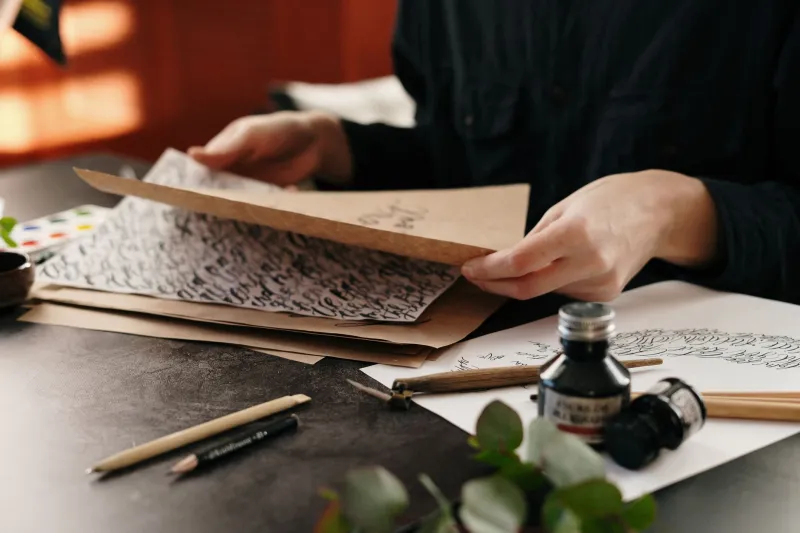
Somewhere between the fifth identical PDF résumé and the third AI-optimized cover letter that opens with "I am writing to express my enthusiasm," something snapped for Margot Ellison. The Brooklyn-based creative director at a boutique branding studio had spent the better part of two hiring cycles staring at applications that felt less like people and more like keyword-stuffed documents trying to outwit a bot. So she did something that felt almost radical: she asked candidates to send something handwritten.
The response was immediate. And deeply uneven. Most applicants panicked. A few sent something so careful and deliberate it was almost painful to read in the best way — ink-smudged, honest, alive. One candidate sent a hand-illustrated one-pager with a short, looping paragraph about why she wanted the job, drawn in the margins like footnotes. Margot hired her.
"It told me more in thirty seconds than any formatted document could," Margot said. "I could see how she thought. How she organized ideas. What she found worth decorating."
The Algorithm Problem Nobody Wants to Talk About
Here's the uncomfortable truth baked into modern hiring: most large companies don't read your application. Not at first, anyway. Applicant Tracking Systems — the software that screens résumés before a human ever touches them — filter by keyword density, formatting compliance, and a handful of metrics that have almost nothing to do with creative instinct or cultural fit. For roles in marketing, design, editorial, or the arts, this is a genuine disaster.
The result is a strange paradox. The more creative the field, the more sterile the application process has become. Everyone is optimizing for the machine, which means everyone sounds the same, looks the same, and gets lost in the same pile.
Analog materials sidestep that entirely. You can't ATS-screen a handwritten letter. You can't auto-reject a hand-bound portfolio. The moment something physical lands on a desk, it demands attention in a way no PDF ever will.
What "Handwritten" Actually Signals
Let's be clear: this isn't about nostalgia. Nobody's arguing that hiring managers want illegible chicken scratch or that a wax-sealed envelope automatically gets you the job. What handwritten and hand-crafted materials communicate is something more specific — intentionality.
When someone sits down to write a cover letter by hand, they can't copy-paste. They can't run it through ChatGPT. They have to think about every sentence before committing it to paper, because crossing out and starting over has actual physical cost. That friction, that slowness, produces something qualitatively different. The writing tends to be shorter, more honest, and more personal. The candidate has to decide what actually matters.
For employers in creative industries, that process is the point. It's not a gimmick — it's a preview of how someone approaches a problem with constraints.
Illustrated portfolios carry a similar weight. When a graphic designer submits physical work — printed lookbooks, hand-annotated tearsheets, even a small zine showcasing past projects — it signals an understanding that presentation is part of the work. That the container matters as much as the content. That's not a minor insight. In most creative roles, it's the whole job.
The Boutique Employer Ecosystem That's Already On Board
This isn't happening everywhere, obviously. Nobody's asking Goldman Sachs for a calligraphed cover letter. But inside a specific ecosystem of employers — indie publishers, small design studios, cultural nonprofits, independent fashion labels, arts organizations, record labels with actual taste — analog application materials have quietly become a genuine differentiator.
Some studios in cities like Portland, Austin, and New York have started explicitly requesting physical submissions for certain roles. Others leave it open but privately admit they respond differently when something tangible arrives. A few have started archiving particularly beautiful application packets the way they'd archive client work — not because they're sentimental, but because they recognize craft when they see it.
There's also a growing community of job seekers who've adopted analog materials as a deliberate personal branding strategy, not just a creative flex. They treat the application itself as a piece of work. The paper stock is considered. The layout is intentional. The handwriting is practiced but not performative. The whole package communicates: I think about how things look and feel. That's not separate from my work — it is my work.
The Vulnerability Factor
Here's what nobody talks about when they romanticize handwritten materials: it's genuinely scary to send them.
A polished PDF is a shield. It's formatted and clean and at a safe distance from your actual personality. A handwritten letter is exposed. Your handwriting is yours in a way your font choice never will be. You can't hide behind a template. If you make a mistake, you have to decide whether to start over or let it stand — and that decision itself says something.
That vulnerability is exactly why it works. Hiring managers, especially good ones, are trying to understand who you actually are underneath the professional performance. Analog materials make that easier. They're not asking for perfection — they're looking for presence.
One editorial assistant at a literary magazine in Chicago described receiving a handwritten cover letter that had a single crossed-out word near the end. The candidate had started a sentence, changed her mind, crossed it out neatly, and continued. "That crossed-out word was my favorite part," the assistant said. "It meant she was actually thinking while she wrote it. It felt real."
How to Actually Do This Without It Backfiring
A few honest caveats before you run home and grab a fountain pen:
Context is everything. Research the company before you decide to go analog. A handwritten letter to a tech startup doing automated HR might genuinely get lost or dismissed. A handwritten letter to a small ceramics studio with three employees is going to land differently.
Legibility is non-negotiable. Beautiful handwriting is great; readable handwriting is required. If your cursive looks like a seismograph, print. The goal is to be understood, not to perform penmanship.
Don't fake the aesthetic. If you're going to hand-illustrate a portfolio, the illustrations should be good. If you're going to use specialty paper, it should feel intentional, not costume-y. Employers in creative fields have sharp eyes. They can tell the difference between someone who genuinely thinks visually and someone who bought nice stationery to seem like they do.
And finally: follow any instructions the employer actually gives. If they ask for a PDF, send the PDF. You can still include a handwritten note with your physical portfolio as a supplement — but ignoring explicit directions to seem creative just reads as someone who doesn't follow directions.
The Bigger Idea
What's quietly happening here is a recalibration of what "professional" means in creative industries. For decades, professionalism meant conformity — clean formats, standard fonts, sanitized language, nothing that might make an employer uncomfortable. That era isn't over, but it's cracking.
The most interesting employers in culture, media, design, and the arts are increasingly interested in candidates who treat their own career as a creative project. Who understand that how you present yourself is an extension of how you'll present your work. Who are willing to be a little vulnerable, a little specific, a little human in a process that has been systematically dehumanized.
Handwriting a cover letter won't save a bad portfolio. But it might be the thing that gets a good one actually read. And in a hiring landscape that's increasingly automated, getting a human to actually pay attention might be the hardest — and most important — creative challenge of all.