Getting Your Hands Dirty: The Unexpected Spiritual Pull of Letterpress, Bookbinding, and Screen Printing
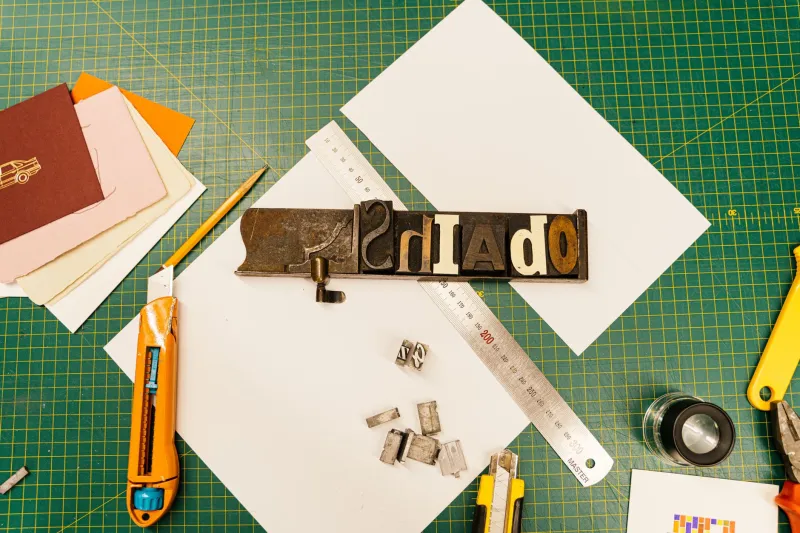
I want to tell you about the first time I watched someone operate a letterpress.
It was in a narrow studio in Minneapolis, the kind of place that smells like ink and wood shavings and something faintly metallic. The instructor — a woman in her late thirties named Claire who had apprenticed under a printer in Vermont before moving back to the Midwest — fed a sheet of thick cotton paper into the machine with the calm efficiency of someone who had done this ten thousand times. The press came down. The paper came out. And on it was a single line of text, pressed into the fiber so deeply you could feel the impression with your fingernail.
The eight students in the room went completely silent.
I've thought about that moment a lot since then. About what it means that a room full of people in their twenties and early thirties, most of whom spend their entire working lives staring at screens, went quiet at the sight of ink and pressure making something permanent on paper. There's something happening here that goes beyond craft nostalgia or aesthetic preference. It feels more like hunger.
The Waiting Lists Don't Lie
Across the US, studios teaching analog craft skills are reporting demand they genuinely weren't prepared for. Arm & Hammer Press in Chicago has a six-week waitlist for its intro letterpress workshop. The San Francisco Center for the Book runs bookbinding intensives that sell out within hours of opening registration. In New York, Prints of Darkness — a screen printing studio in Ridgewood, Queens — added three new beginner sessions this year and still couldn't keep up.
This isn't a niche phenomenon anymore. It's showing up in mid-sized cities too: Durham, Denver, Kansas City, Tucson. Makerspaces that used to focus primarily on laser cutters and 3D printers are adding analog print stations because members keep asking for them. Community colleges are reviving printmaking programs they quietly defunded a decade ago.
The demographics skew young and creative-professional. A lot of graphic designers. Architects. Writers. People who work in digital media. Which is exactly the cohort you'd expect to be most saturated with screens and most desperate for an antidote.
Why Now, Specifically
Let's not pretend this is happening in a vacuum. We are living through a particular kind of digital exhaustion — not just from work, but from the specific texture of contemporary online life. Everything is instantly replicable, infinitely scrollable, and designed to feel both urgent and disposable. The algorithmic churn is relentless. The attention economy is genuinely brutal.
Against that backdrop, the appeal of a process that is slow, physical, irreversible, and entirely yours starts to make a certain emotional sense.
"People come in burned out and they leave grounded," says Tomás Rivera, who teaches screen printing at a community studio in Austin. "I don't think they always know that's what they're looking for when they sign up. But after they've spent four hours mixing ink and burning screens and pulling squeegees, something has shifted. You can see it in their faces."
There's actual psychology behind this. Research on what's sometimes called "embodied cognition" suggests that working with our hands in tactile, repetitive ways activates parts of the brain associated with focus and emotional regulation that screen-based work tends to suppress. Making something physical — something you can hold, feel the weight of, smell — produces a kind of satisfaction that digital creation, for all its power, doesn't quite replicate.
Bookbinding instructors talk about this constantly. "The sewing is meditative," says Priya Nair, who teaches traditional Coptic and Japanese stab binding out of a studio in Philadelphia. "By the third signature, people stop talking. They're just in it. That's rare. That's something people are starving for."
Creative Currency in a Saturated Market
There's a more pragmatic dimension to this revival too, and it's worth being honest about it. In a creative landscape where everyone has access to the same Canva templates and Adobe presets, handmade craft skills are becoming a genuine differentiator.
A letterpress-printed business card in 2024 communicates something no digital design can replicate. A hand-sewn zine with a screen-printed cover is an object, not just content. Illustrators and designers who can produce limited-edition risograph or screen-printed prints have an entirely different kind of product to sell — one that carries the aura of the handmade and commands prices that reflect it.
For a generation that came of age watching the internet commodify and flatten creative work, analog production offers something increasingly valuable: scarcity. You can't infinitely reproduce a letterpress print without the physical setup. The limitation is the point.
"I started doing bookbinding because I wanted to make something I couldn't just copy-paste," says Keanu Reeves — no, not that one — a 24-year-old graphic designer in Portland who now sells hand-bound notebooks and journals at local markets. "Every book I make is slightly different. That feels important right now in a way I can't totally explain."
More Than a Skill, Less Than a Religion
I want to be careful not to over-romanticize this. Learning letterpress doesn't save you from burnout. Bookbinding isn't therapy, even when it feels like it. And there's a real question about accessibility — quality workshops aren't cheap, and the tools themselves represent a significant investment that puts serious practice out of reach for a lot of people.
Some studios are working on this. Sliding-scale pricing. Community memberships that subsidize access. Open studio hours where people can use equipment independently after completing a basic course. It's not a solved problem, but it's being taken seriously.
What's harder to dismiss is what these spaces represent culturally — a genuine counterweight to the idea that making things means making digital things. That value is created by scale and speed. That your creative output only matters if it can be distributed.
The letterpress doesn't care about your follower count. The ink dries whether or not anyone sees it. And the thing you made with your hands is real in a way that a file on a server, however beautiful, will never quite be.
That's not nothing. Right now, for a lot of people, it might be everything.